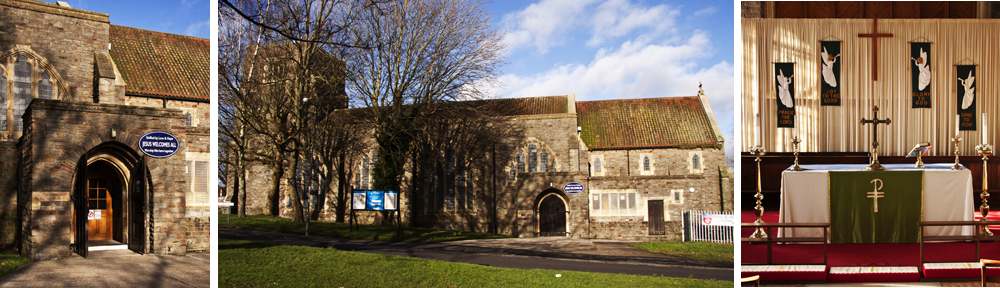
The parish of Saint Oswald, Bedminster Down, was created from portions of the parishes of Saint Peter’s, Saint Aldhelm’s, and Saint Dunstan’s.
On November 5, 1927, the foundation stone of the church was laid by Mrs. Ida Richardson, in the presence of the Bishop of Bristol, the Right Reverend George Nickson. The architect was Mr. P. Hartland-Thomas, F.R.I.B.A., and the builders were Messrs. Cowlin Ltd.
The church was constructed in just one year, and on Sunday, October 21, 1928, it was consecrated as the new Church of Saint Oswald, King of Northumbria and Martyr, by the Bishop of Bristol, assisted by the Right Reverend Ronald Ramsey, Bishop of Malmesbury.
The church was converted into a Church Centre and re-dedicated on Sunday, October 23, 1983. Fifteen years later, in 1998, the interior of the church was “re-ordered” for worship as we approached the Millennium of our Lord’s birth and beyond.
St. Oswald, a prominent figure in the history of Northumbria, was a member of the region’s royal family. His journey into leadership and faith was marked by a significant period of exile, during which he sought refuge among the Scots. It was here that he embraced Christianity, a decision that would shape not only his life but also the future of his kingdom.
After years of turmoil, Oswald successfully reclaimed his throne through a series of decisive and strategic battles against his rivals. Recognising the potential for unity and the power of faith to bind his people, Oswald actively sought to spread Christianity throughout Northumbria. In a notable move to strengthen the Christian faith in his realm, he requested that the Scottish elders send a bishop to support his mission. This request led to the establishment of a Christian see at Lindisfarne and the arrival of Bishop Aidan, who would work alongside Oswald to evangelise in the region.
In the early days of Aidan’s mission, Oswald played a crucial role by serving as his interpreter during sermons, facilitating communication until the bishop was able to learn English. This collaborative spirit exemplified their partnership and underscored Oswald’s commitment to promoting Christianity. Beyond his interpretive duties, Oswald actively supported the Church by generously donating land and financial resources for the establishment of monasteries, which became centres of learning and spiritual growth. His commitment to aiding the less fortunate was evident through his practice of giving alms to the poor, demonstrating a holistic approach to leadership that encompassed both spiritual and social responsibilities.
Through his leadership and vision, St. Oswald gradually succeeded in uniting various British kingdoms and provinces, thus laying the foundation for a more cohesive Christian society. His reign was not without conflict, and he ultimately met his end in battle in the ninth year of his reign, in 642 AD. Oswald is remembered not only as a devout Christian king but also as a spiritual warrior who fought for his faith and his people.
While the exact reason why the Diocese chose to dedicate the church in Bedminster Down to St. Oswald remains a mystery, his legacy as a unifier and promoter of Christianity continues to resonate through history, reflecting the enduring impact of his life and leadership on the faith in Britain.
Information by Peter Halladay
 St. Oswald's Church